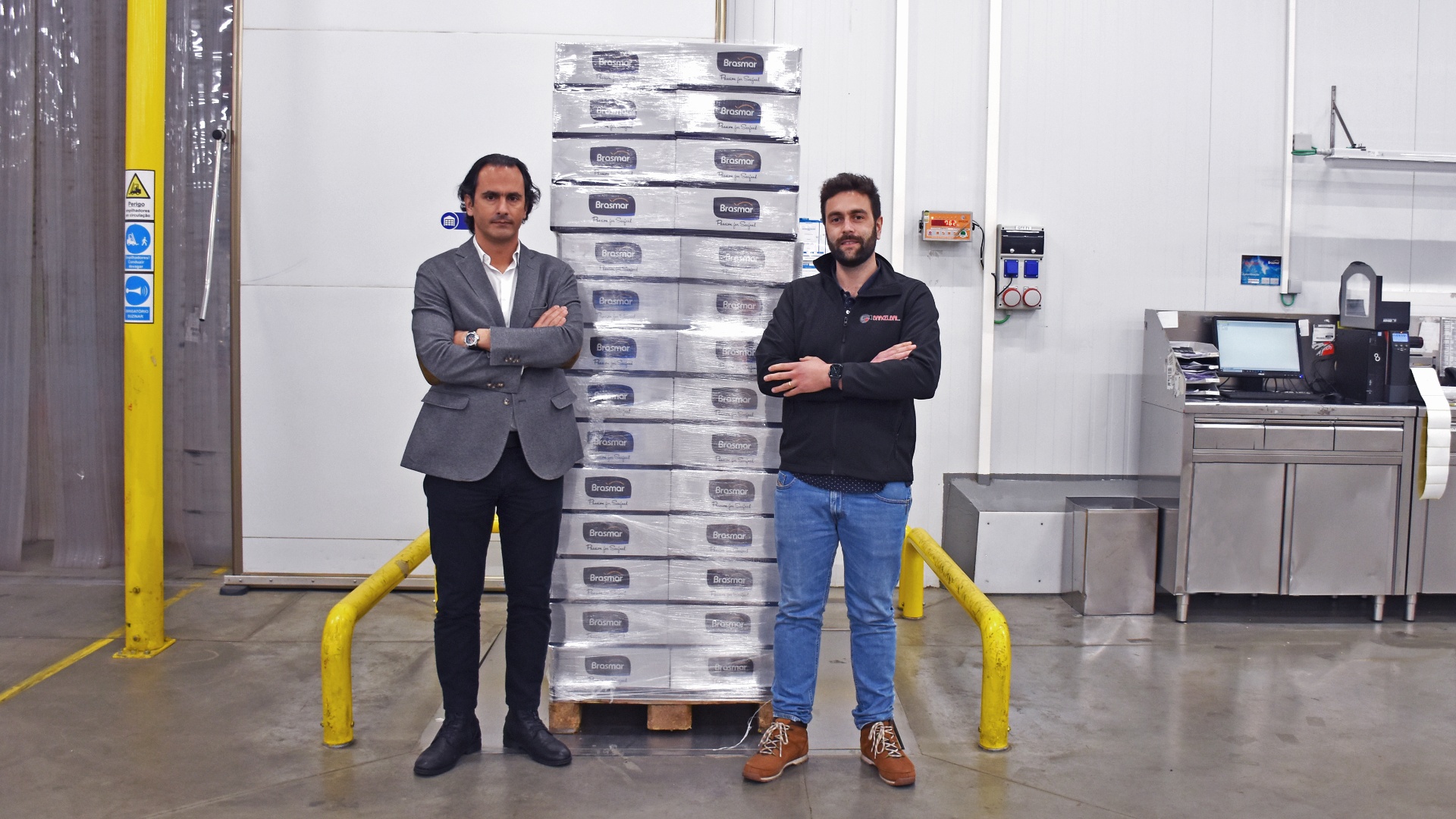
Eng. Amândio Miranda on the left and Eng. Joaquín Correia
Portugal has a long tradition of processing pine resin. Until the 1970s, it was a major producer and became the world’s second largest producer of pine resin. Although it lost production capacity after the 1970s, it never lost its processing capacity, and small distilleries continued to process pine resin.
In 2013, some of the founding shareholders of Gum Chemical Solutions had the idea of creating a more modern and technological pine resin processing company in Portugal, while maintaining the traditional principles of the activity.
In 2015, construction began, at the end of that year the first tests were carried out, and in 2016 operations began.
We spoke with Joaquín Correia, Head of the New Projects Department.
Joaquín Correia studied Chemical Engineering and Civil Engineering. He worked in the chemical industry for several years, then moved into the energy sector, specifically gas, and is now Head of the New Projects Department at Gum Chemical.
At Gum Chemical, he began by overseeing the construction of the industrial unit and the installation of the equipment.
“I used to tell the contractors to be careful because the referee was from the same club!”
– Eng. Joaquín Correia
When Gum Chemical began operations, the engineer moved to the production area and is now in the New Projects Department. However, even today, any changes in the civil construction or mechanical areas still go through the engineer.
During these seven years, Joaquín Correia’s greatest challenge was to start the Gum Chemical project from scratch, and the most ridiculous situation occurred when a steam shirt burst.
“Starting Gum wasn’t easy! It was hard, but it was also fun!”
– Eng. Joaquín Correia
“We had a steam shirt explosion where I shot out of the middle of the steam cloud! Now I find it funny, but at the time it was a bit scary.”
– Eng. Joaquín Correia
CHEMICAL SOLUTIONS FOR COUNTERTOPS

Gum Chemical Solutions facilities in Cantanhede
The lack of investment in Portuguese forests, artisanal resin and low production volumes force Gum Chemical to import raw materials from abroad, with South America being its main supplier.
Portugal produces very small quantities of raw pine gum, which would only be enough to supply Gum for three months. Therefore, it is necessary to import the raw material. We have already received samples from southern Africa, but our main supplier is South America. We are still looking for new suppliers; for example, we are currently awaiting raw material from Indonesia.
– Eng. Joaquín Correia
Pine resin (raw pine gum) produced in Portugal arrives at Gum Chemical in metal drums, while pine resin imported from South America is transported in plastic sacks which, to maintain their shape when loaded into containers, are packed in cardboard boxes.
Gum Chemical receives around 70 tonnes of pine resin daily, which is transformed into its fundamental components, turpentine and rosin.
We produce two products: turpentine, the old turpentine, which many people today do not even know what it is, and rosin, which the ancients called Pez.
– Eng. Joaquín Correia
The product produced in the largest quantities is rosin, which accounts for between 65% and 70% of production. Rosin can be used to manufacture various products, such as glues, paints, varnishes and depilatory waxes, which have different characteristics.
Our customers can select a narrower range, but never outside the defined range. We are fortunate because when it does not turn out so well, we know that another customer will want it. Obviously, we always try to get it right the first time.
– Eng. Joaquín Correia
Engineer Joaquín Correia does not consider Portuguese pine resin to be better than others, only that it allows things to be done that other resins do not, just as other resins allow things to be done that Portuguese resin does not. The engineer points out that, just as pine trees, species and climates are different, resin is produced in different quantities and with different characteristics.
Therefore, the origin of the resin defines the final product that can be obtained, within a certain range.
The production process at Gum Chemical is so automated that there are no machine operators, only people who supervise the production process.
To date, Gum Chemical’s production process is considered a chemical process, but there are no chemical reactions, only distillation and filtration.
«The only product for human use that contains rosin in large quantities and with almost no chemical processing, only with the addition of other components, is something that no one remembers, except for the ladies who visit Gum. When they visit Gum, they say it smells like wax.
– Eng. Joaquín Correia

Gum Chemical Solutions facilities in Cantanhede
Gum Chemical’s production process is just-in-time, with no need for large product storage, as distribution is easy.
According to engineer Joaquín Correia, the pine resin transformation process is relatively quick; what prolongs the process is the transport time for the raw material and the final product.
In addition, the production process is relatively fast. The longest times are those for the arrival of the raw material at Gum Chemical and the arrival of the product at the customer.
Gum Chemical’s production capacity can reach 100 tonnes per day. However, bottlenecks in maritime transport have caused large fluctuations in production.
“Traffic congestion greatly influences the price of raw materials. Gum depends entirely on the arrival of raw materials and the shipment of products, because we do not have infinite storage capacity. We suffered greatly with turpentine, which is a liquid transported in containerised tanks, which were in even shorter supply than traditional containers. No matter what we paid, we had no transport.”
– Eng. Joaquín Correia
Gum Chemical’s customers are involved in the secondary processing of pine resin, i.e. they process turpentine and rosin.
Its customers are mainly located in India, China and Europe. Although they sell in Portugal, around 50% of the products produced by the secondary processing industry are ultimately exported.
“We are not dependent on a single destination, but we also cannot afford to be selective about destinations. Our Sales Department is always looking for new customers.”
– Eng. Joaquín Correia
The Research Department and protocols with the University of Coimbra allow Gum Chemical to always be at the forefront of innovation and ahead of the market.
This important factor has enabled the implementation of a new project with the development of a new production process, which will include the installation of a second truck weighbridge.
Gum is not the only industry that processes raw pine resin, but it is the largest. Even when it was first established, I believe it was the largest in the world. Today, we continue to lead in terms of processing volume and technology. Since 2016, if we have had a month without minor changes, additions, modifications, or increases, it has been a lot. Gum is always on the move! At Barcelbal, it’s an average of one scale every six years (laughs), but we can’t install scales everywhere either.”
– Eng. Joaquín Correia
Gum Chemical is at the forefront of the pine resin processing market and has an average annual turnover of €22 million.
SUSTAINABILITY IN THE PINE RESIN INDUSTRY

Gum Chemical Solutions facilities in Cantanhede
Gum Chemical operates in a sector with high energy costs. The transformation process consumes a lot of energy, as the rosin must be heated to high temperatures of around 170º from start to finish. To reduce energy costs, Gum Chemical operates 24 hours a day, 330 days a year, because stoppages mean that everything cools down and the costs of resuming activity are high.
“We have always been careful and sought to optimise our energy use. Imagine a small distillery that only operates 12 hours a day and shuts down on weekends, in addition to having low productivity and high energy costs. These distilleries have their niche, for example, for us, as raw pine gum is produced in small quantities, and sometimes it does not make sense to include it in our production process.”
– Eng. Joaquín Correia
In Portugal, many of Gum Chemical’s customers receive liquid rosin, which reduces energy costs. However, when it is exported, it must be shipped in solid form, which entails high energy costs to reheat the rosin when it reaches the customer.
“Gum is in the pine tree sector, which has been working since the beginning, and is something beautiful because it can be sustainable! Many of Gum’s customers compete with the petroleum derivatives industry. These customers have seen a decline in recent decades because petroleum has become commonplace, but as there are products that cannot be completely replaced by petroleum derivatives, the market has continued to exist. Now, with the recognition of the importance of the environment, there is already increased interest in paying a little more for a product that is part of a sustainable supply chain.”
– Eng. Joaquín Correia
Although the pine resin transformation process is natural and organic, Gum Chemical holds environmental quality and safety certifications.
“As long as there is a good relationship between the agents, the pine industry can be sustainable. Speaking of Gum, despite the different interests between the various areas, things have been progressing well.”
– Eng. Joaquín Correia
IMPORTANCE OF SCALES IN THE GUM CHEMICAL PRODUCTION PROCESS

Barcebal metal truck weighbridge installed at Gum Chemical Solutions
“The scales are everything (laughs). Mind you, I’m not just saying that to flatter you, it’s true!”
– Eng. Joaquín Correia
Gum Chemical buys pine resin and sells turpentine and rosin by weight. As such, the Truck Weighbridge installed at Gum Chemical is used to control the entry of raw materials and the exit of products.
There are other scales in your production process, but the final weighing is always carried out on the Truck Weighbridge.
“A lorry carrying 24 pallets must be within a certain weight range. When the weight is not within this range, production is immediately contacted to ask if the weight is correct. We have already detected production faults using the weighbridge.”
– Eng. Joaquín Correia
The first truck weighbridge installed at Gum Chemical is made of metal with concrete ramps. The second is also made of metal and embedded in the ground. Both measure 16x3m and have a capacity of 60 tonnes.
Gum Chemical also uses TruckinGest software to control the weighing of both scales.
Barcelbal has always been humble enough to listen to us and not impose solutions on us. You make suggestions and talk to us. That’s the big difference. I can’t remember a single situation where we chose your competitors. Not only because of the scales, but also because you provide support services. In fact, not long ago we asked for a change in the software so that the exported data could be integrated into our daily maps.”
– Eng. Joaquín Correia

Barcebal metal truck weighbridge installed at Gum Chemical Solutions
—